



Ambisius vs Airtable — which one actually fits how your business operates?
Two Very Different Tools, Often Compared
There's a difference between a tool that can work for your business and one that actually fits how your business runs day to day.
Airtable shows up in every "best tools for small business" list — and for good reason. But if you're a business owner managing inventory, bookings, staff, or clients, the real question isn't which tool has more features. It's which one you'll actually be able to use without spending weeks learning it.
In this post, we break down exactly how Ambisius and Airtable compare — not from a feature-spec perspective, but from the angle of a real business owner who needs a working system fast.
What Is Airtable?
A powerful database platform — built for teams that already know what they're doing.
Airtable is a cloud-based database platform that blends the look of a spreadsheet with the power of a relational database. It was built for teams who need flexible data management — think project tracking, content calendars, product roadmaps, and CRM pipelines.
-
Genuinely flexibleCreate linked tables, build custom views, set up automations, and connect to hundreds of other tools via integrations.
-
Strong following among tech teamsStartups, marketing teams, and operations managers at mid-to-large companies love it for structured data management.
-
Steep curve for non-technical usersIf you have no database background, Airtable can feel like assembling furniture without instructions — the pieces are all there, but figuring out how they fit takes real time and effort.
What Is Ambisius?
An AI-powered app builder that turns your business description into a fully working system — in minutes.
Ambisius is built specifically for small and medium businesses. Instead of configuring database fields manually, you simply chat with an AI — describe what your business needs — and the app is built for you automatically.
Describe your business in plain language — Ambisius builds the entire app for you automatically.
-
No coding, no configurationYou describe what you need in plain language. The AI handles tables, relationships, calculated fields, validations, dashboard, and analytics — automatically.
-
Built for real business workflowsInventory tracking, appointment scheduling, invoicing, event registration — all through conversation, not configuration.
-
Replaces spreadsheets and WhatsAppBuilt for business owners who are currently managing operations on spreadsheets or notebooks and want a proper system without hiring a developer.
Head-to-Head Comparison
How the two tools stack up across the things that matter most to a small business owner.
| Feature | Ambisius | Airtable |
|---|---|---|
| Built for | Small business owners (SMEs) | Tech-savvy teams & startups |
| Setup | Chat with AI — app ready in minutes | Manual table setup, field configuration |
| Technical skill needed | None | Moderate — requires database concepts |
| Customization | AI-driven, fully custom to your workflow | Flexible but manual — you configure everything |
| Auto Calculation | ✅ Built-in | Limited — requires formula knowledge |
| Data Relations | ✅ Built-in | ✅ Available — but requires manual setup |
| Validation & Error Prevention | ✅ Built-in (range, overlap, uniqueness) | Limited — basic only |
| Team Collaboration | ✅ Per-menu access control | ✅ Role-based per base |
| Notifications / Alerts | ✅ Condition-based smart alerts | Limited — via Automations (setup required) |
| Customer-Facing Sharing | ✅ Publish as customer-facing app | Limited — shared views only, not full apps |
| Mobile App | ✅ iOS, Android, PWA | ✅ iOS & Android (limited functionality) |
| Ready-Made Business Templates | ✅ Inventory, Appointments, Invoices, Events | ✅ General templates — not SME-specific |
| Pricing model | Credit-based — pay for what you build | Per-seat subscription — scales with team size |
Detailed Breakdown
Four areas where the difference between the two tools is most felt by a real business owner.
1. Ease of Setup: Minutes vs. Days
With Airtable, getting started is deceptively easy — you can create a table in minutes. But building something that actually works for your business is a different story. You need to manually define every field type, set up table relationships, configure views, write formulas, and figure out how to share it with your team. For someone without a database background, this process can take days.
With Ambisius, you describe what you need in plain language — and the AI builds the entire app automatically. Tables, relationships, calculated fields, validations, dashboard, and analytics — all ready without touching a single setting.
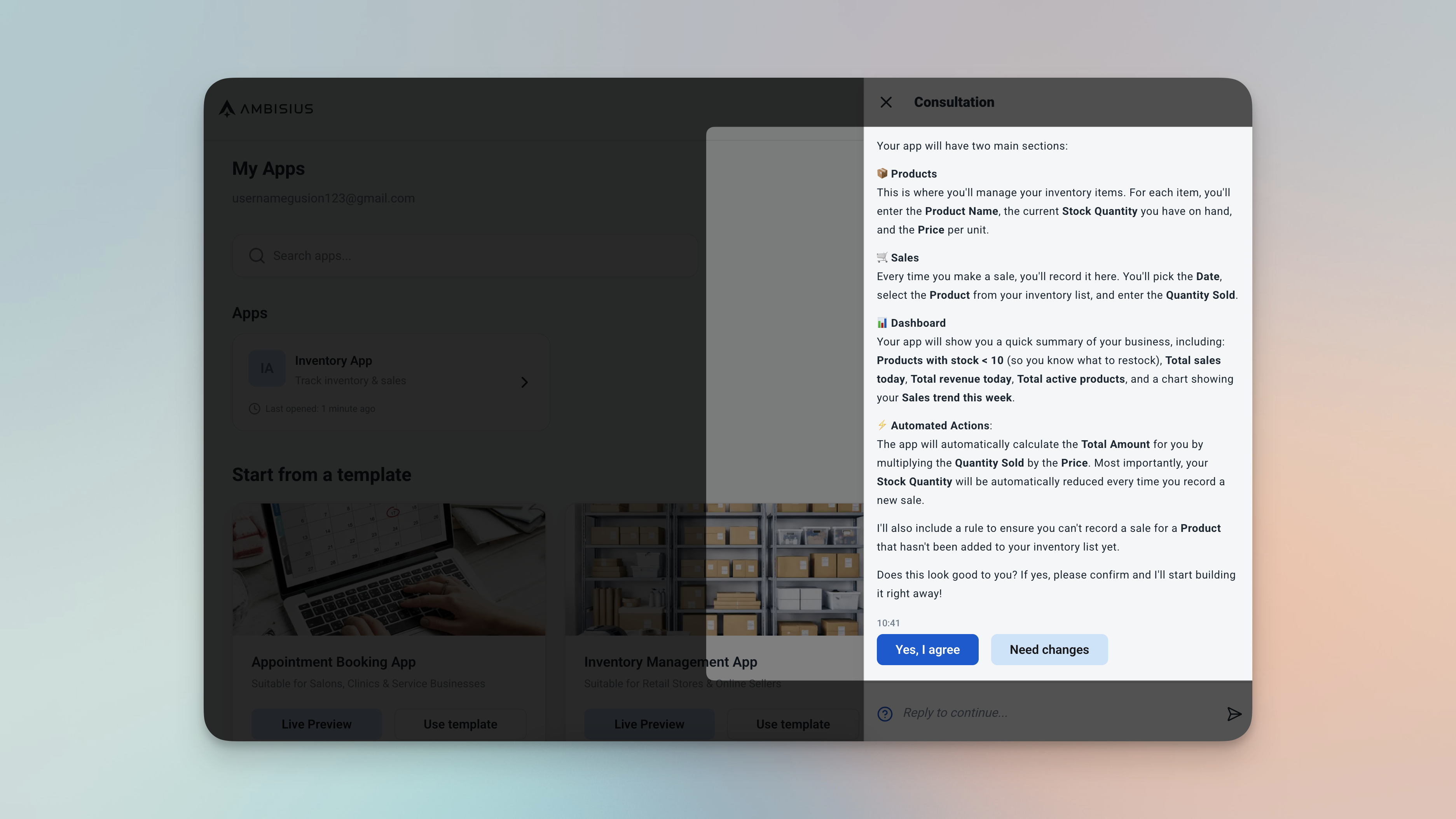
Describe your business — Ambisius builds the full app, including tables, dashboard, and analytics, in minutes.
For a small business owner, the difference isn't just time — it's the difference between actually having a working system and abandoning the tool after a frustrating weekend of setup.
2. Business Logic: Does the Tool Think Like Your Business?
Airtable is a database tool — it stores and organizes data well. But it doesn't come with built-in business logic. Things like preventing a sale when stock is zero, automatically calculating an appointment's end time, or blocking a double-booking require Airtable's Automations and formula fields — which take technical knowledge and ongoing maintenance to build.
Ambisius is built with business logic at its core. These aren't add-ons you configure — they're built into how the platform works.
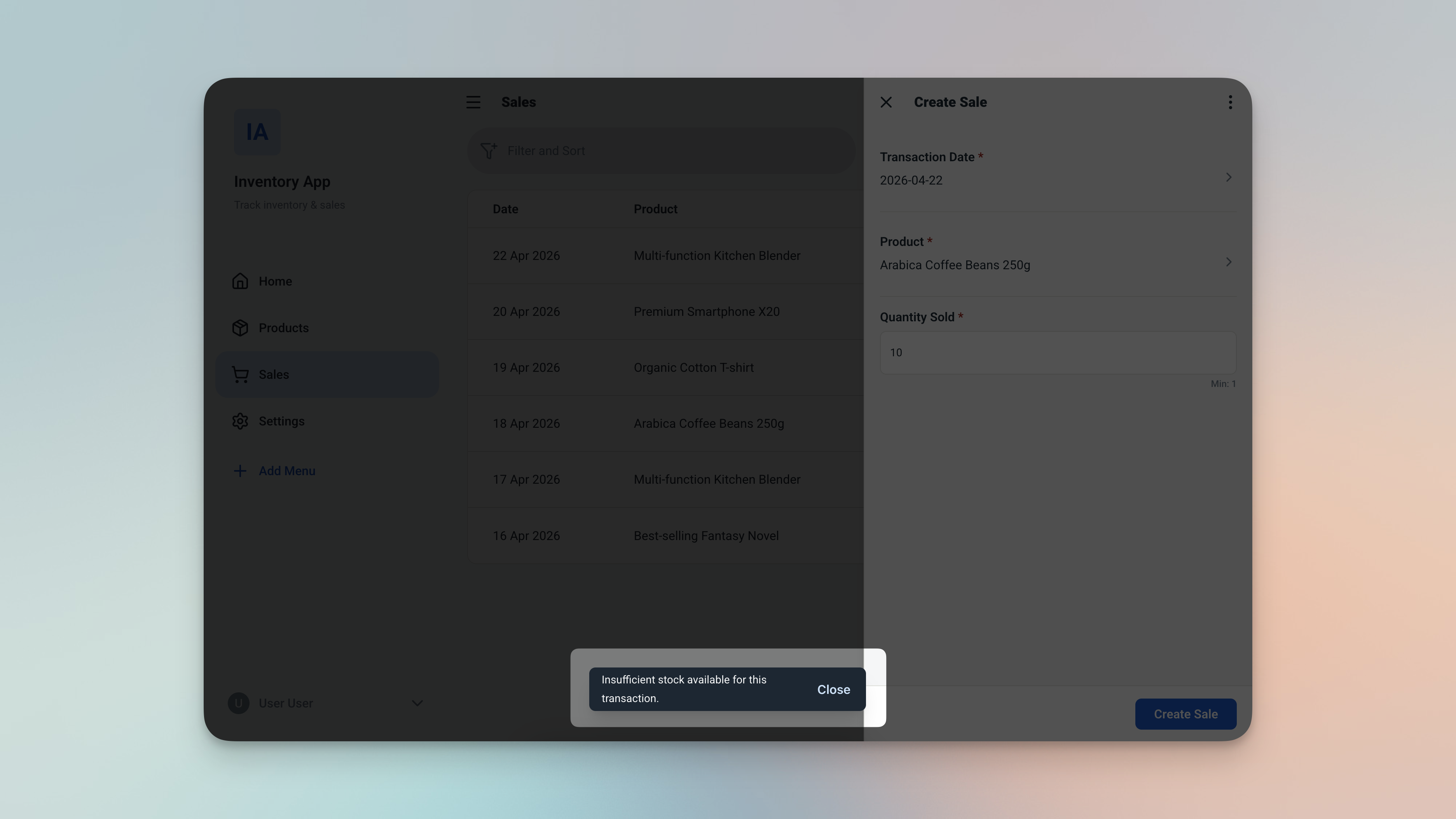
Business logic built in — end times calculate automatically, and conflicting bookings are blocked before they're saved.
3. Team Collaboration: Control vs. Complexity
Both tools allow you to share access with your team — but the experience is very different. In Airtable, you share at the "base" level with broad roles. It's hard to say "this person can only add sales records, but can't see the analytics or edit product prices."
In Ambisius, access control works per menu and per action — giving you precise control over exactly what each team member can see and do.
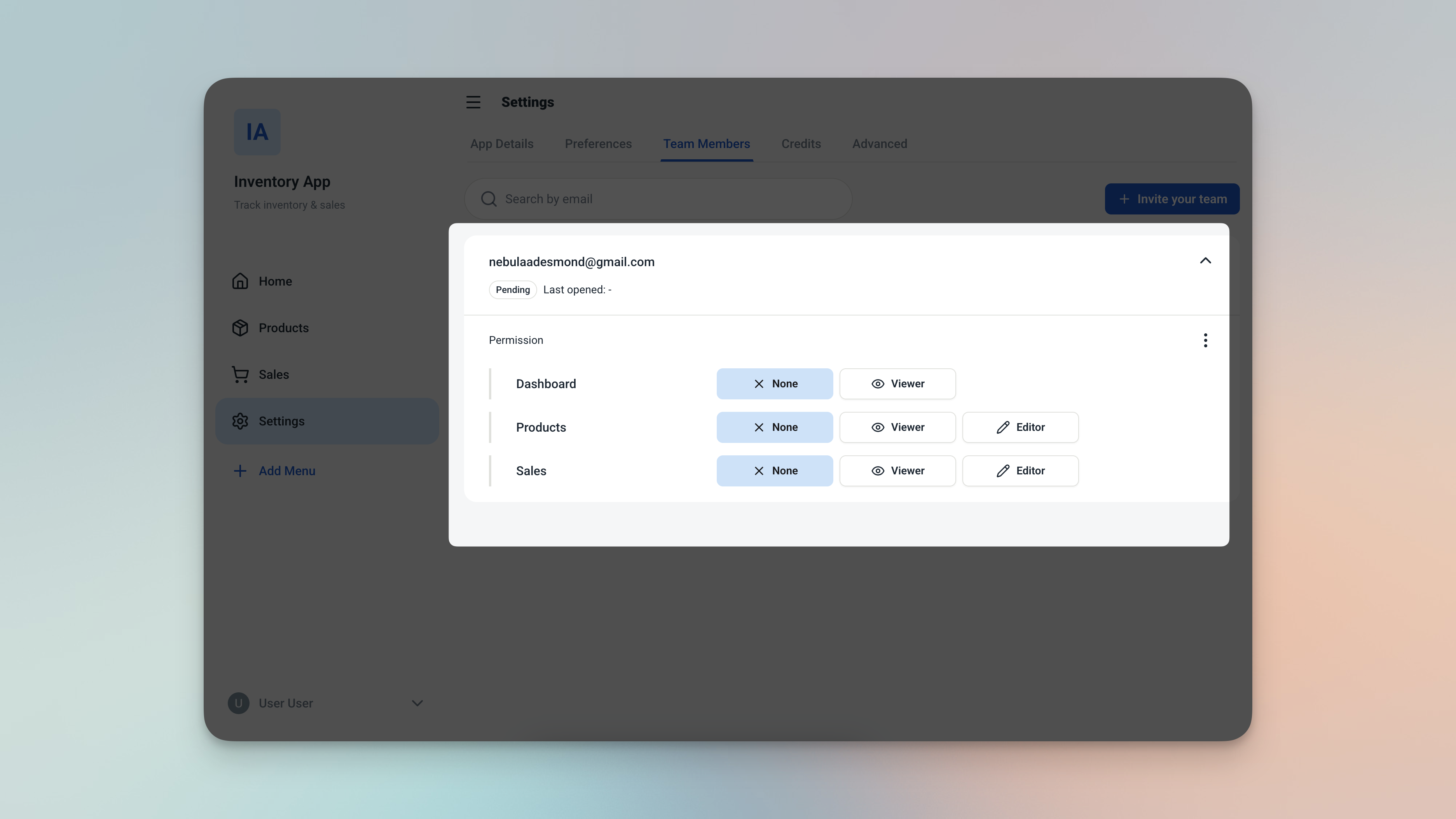
Per-menu access control in Ambisius — set exactly what each team member can see and do, down to individual actions.
| Role | Can Do | Cannot Do |
|---|---|---|
| Cashier | Add sales records | Edit product prices, delete records |
| Warehouse Staff | Add stock | View sales analytics |
| Manager | View everything | Delete records |
| Owner | Full control | — |
4. Pricing: Seats vs. Usage
Airtable's pricing is per-seat — the cost grows as your team grows. Once you need advanced automations, increased record limits, or admin controls, you're on paid plans that add up quickly for a small team.
Ambisius uses a credit-based model — you pay for what you actually build and change, not for how many people use the app. Chatting with the AI and exploring is free. Credits are only consumed when you confirm a change and the AI applies it. New users also receive free starter credits to try the product before committing.
For a small business with a tight budget and a growing team, the difference between paying per seat and paying per change is significant — especially as your team scales.
Verdict — Who Should Use What?
The right tool depends on your team's technical capacity and how fast you need a working system.
Choose Airtable if:
-
Your team has technical experienceIf someone on your team is comfortable with databases or spreadsheet tools, Airtable's flexibility is a genuine advantage.
-
You need deep third-party integrationsAirtable connects to Slack, Zapier, Salesforce, and hundreds of other tools — ideal for teams already embedded in a larger software stack.
-
You have dedicated ops staff to maintain the systemAirtable rewards investment. If you have someone who can build and maintain it, it's a powerful platform.
Choose Ambisius if:
-
You're running on spreadsheets or WhatsApp right nowAmbisius is built exactly for this transition — from informal tools to a proper business system, without the learning curve.
-
You have no technical backgroundNo formulas, no drag-and-drop configuration, no database setup required. You describe what you need — the AI handles everything else.
-
You need business rules enforced automaticallyNo overselling, no double-bookings, no duplicate entries — Ambisius enforces your rules without you having to think about it.
-
You want precise control over staff accessShare the app with your team while staying in full control of who sees and does what — per menu, per action.
-
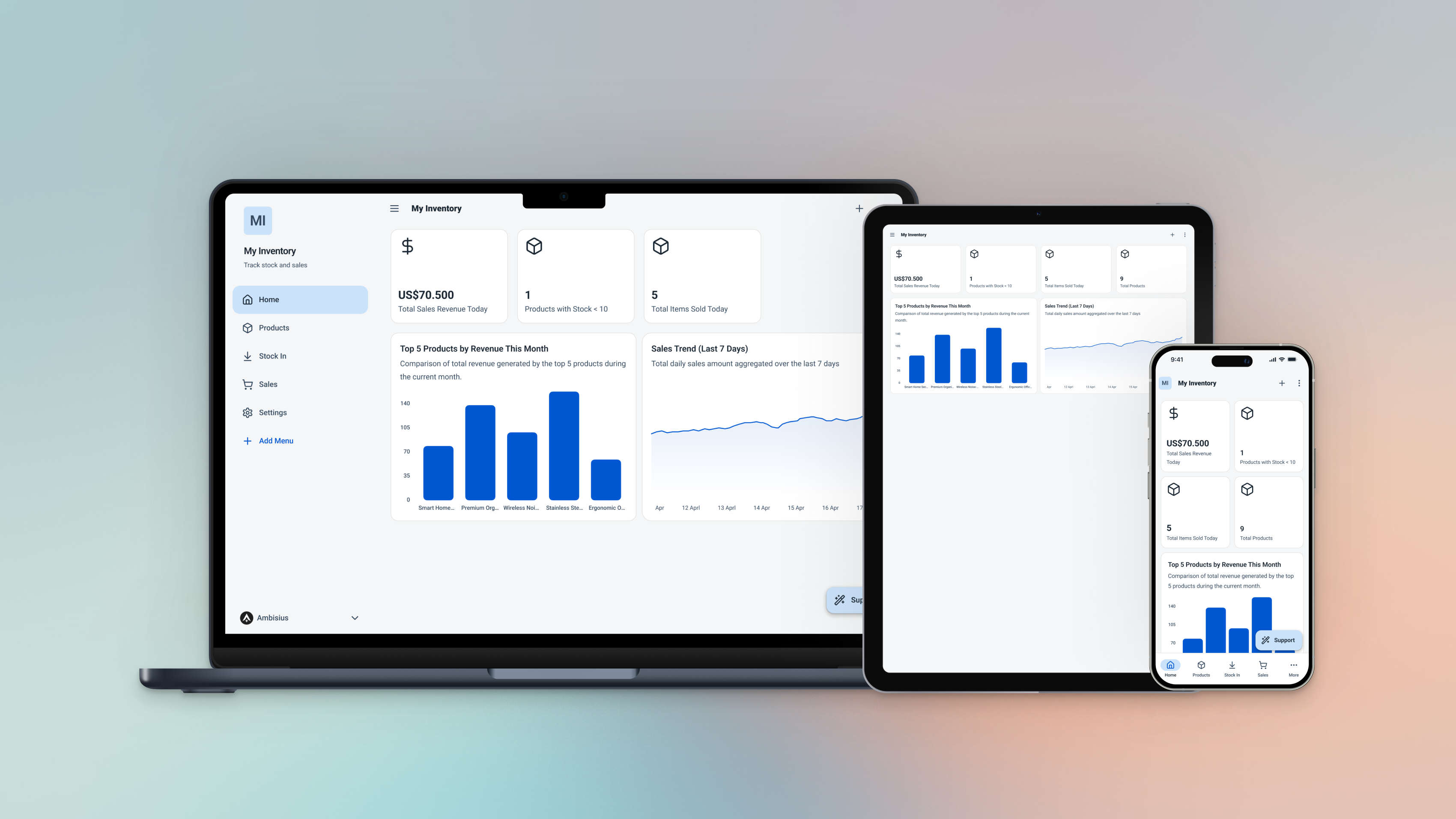
You need it to work on every device out of the boxAmbisius is fully responsive across iOS, Android, tablet, and desktop browser — the same app, everywhere your team works.
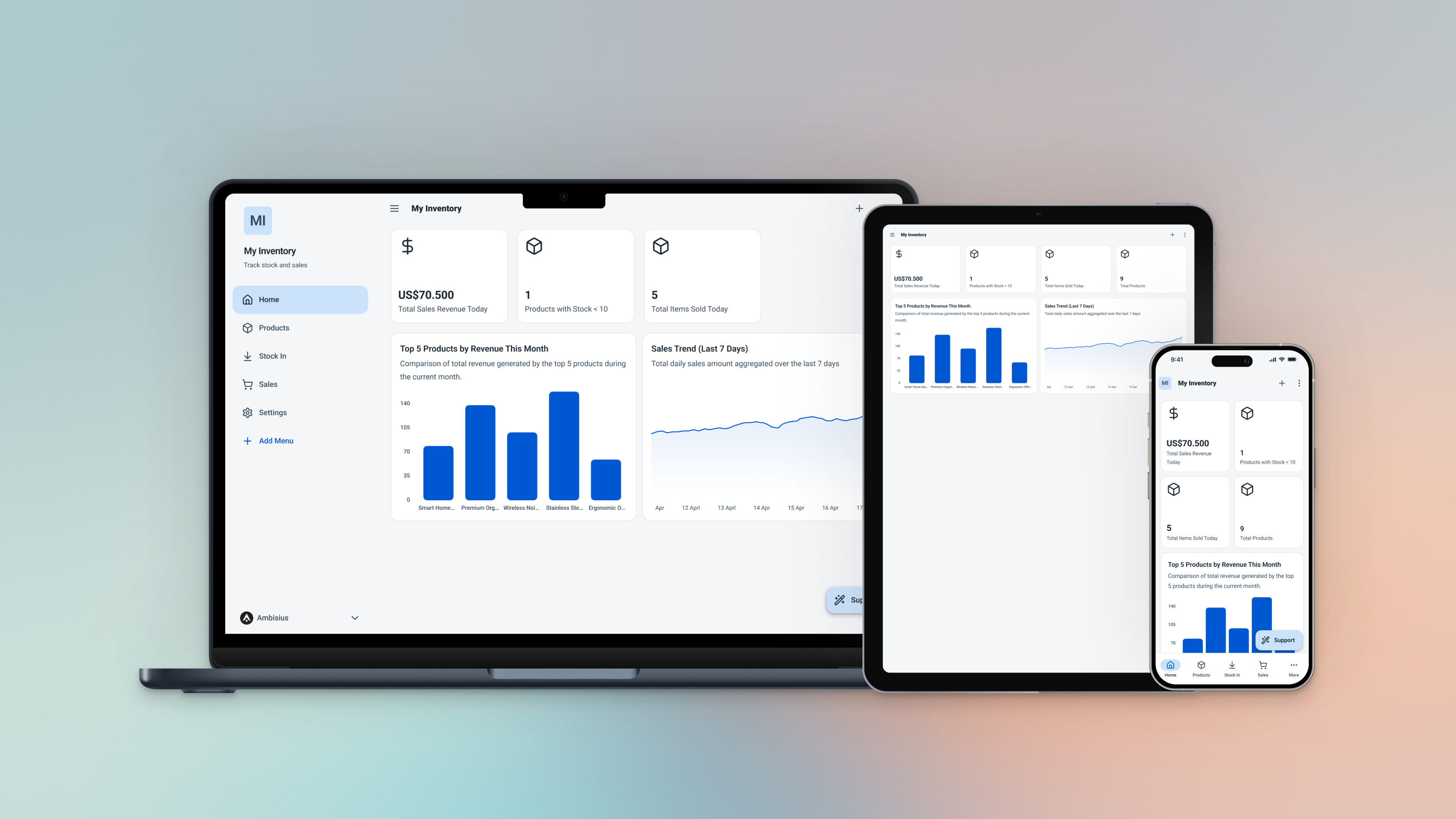
Ambisius works seamlessly across every device your team uses — phone, tablet, and desktop, out of the box.
See It for Yourself — No Setup Required
Getting started with Ambisius takes minutes, not days.
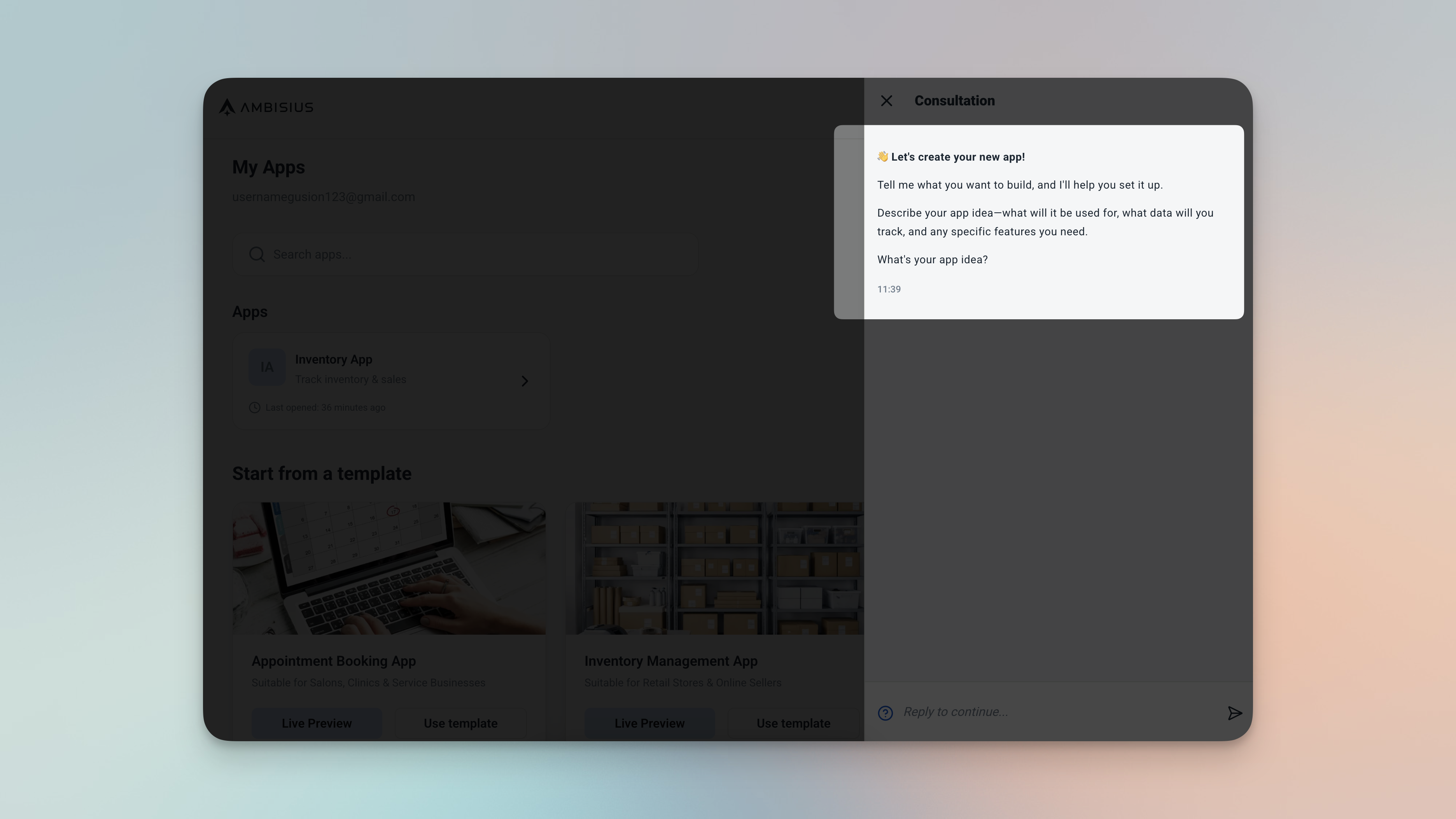
Start by describing your business — your app is ready before you finish your coffee.
Who Ambisius Is Built For
If you're running a business on spreadsheets, WhatsApp, or notebooks — Ambisius was made for you.
Frequently Asked Questions
-
Is Airtable good for small business operations?Airtable can work for small businesses, but it's best suited for teams with some technical experience. If your business needs inventory tracking with stock validation, appointment scheduling with double-booking prevention, or role-based staff access — you'll need to build those behaviors yourself in Airtable. Ambisius comes with these built in.
-
Can I migrate from Airtable to Ambisius?Yes. Describe your existing setup to Ambisius via chat and the AI will build an equivalent — or better — system for you. Your data can be re-entered or imported as you transition.
-
Is Ambisius free to use?Ambisius uses a credit-based model. Chatting with the AI and exploring the platform is free. Credits are only used when you confirm a change and the AI applies it to your app. New users receive free starter credits to get started without any upfront commitment.
-
Do I need coding skills to use Ambisius?No. Ambisius is built specifically for non-technical users. You describe what you need in plain language — the AI handles everything else. No formulas, no drag-and-drop configuration, no database setup required.
-
How long does it take to build an app on Ambisius?Most business apps — including tables, relationships, validations, a dashboard, and analytics — are ready in minutes. You can then continue refining via chat and changes are applied instantly.
-
Does Airtable have a mobile app?Yes, Airtable has iOS and Android apps, but the mobile experience is limited compared to the desktop version. Ambisius is fully responsive across iOS, Android, tablet, and desktop browser — the same app works seamlessly on every device your team uses.
The Bottom Line
Airtable is a genuinely powerful tool — for teams that have the technical capacity to unlock it. But for a small business owner who needs a working operational system without the setup headaches, the learning curve, or the per-seat pricing — Ambisius is the stronger choice.
You describe your business. The app appears. Your team uses it. That's it.
